Thursday, March 13, 2014

Activities to increase COURAGE & PERSEVERANCE in your classrooms...

Activities to increase

courage and perseverance
in your classrooms…
      Possible Read Alouds: The Little Engine that Could by Watty Piper, Free: Stories About Human Rights, The Story of Ruby Bridges by Robert Coles, Sheila Rae the Brave by Kevin Henkes, The Paper Bag Princess by Robert Munsch, Thank You Mr. Falker by Patricia Polacco, Letters from Rifka by Karen Hesse, Joey Pigza Swallowed the Key by Kate DiCamillo, Amazing Grace by Mary Hoffman, Because of Winn Dixie by Kate DiCamillo, Wonder by R.J. Palacio, Playing with the Boys by Nicole Leigh Shepherd, I Love You Dude by Vladimir Radunksy, Estrela The Star by Nicolaas Lems, Wilma Unlimited by Kathleen Krull, The Recess Queen by Alexis O’Neill, The Sissy Duckling by Harvey Fierstein, Number the Stars by Lois Lowry, Kids With Courage by Barbara A. Lewis.


      Read Maya Angelou’s poem “Life Doesn’t Frighten Me” to your students. Have them change the words to fit their own life, write a new poem on the subject, or illustrate the poem with drawings or from pictures in a magazine.
      Do a biographical study on Helen Keller.  Afterwards, have students research and give presentations on what it means to be blind/deaf, how this would affect your life, and how people with disabilities are the same or different.  Also visit PBS Kids website, “You’ve Got Braille” at http://www.pbs.org/teachers/connect/resources/3872/preview/ to expose your students to forming letters in Braille.
      Check out the film “The Mighty Macs,” the true inspiring story about an obscure women’s basketball team having the courage to persevere through an unlikely championship season (found on Netflix instant watch).
      Have students create Power Point presentations around people in history who have persevered through difficult situations. Check out this video for inspiration: http://www.youtube.com/watch?v=EcXQoUZrJpU&sns=em
      Link “No Name Calling Week” into being a community of Courageous Upstanders: http://www.schoolclimate.org/bullybust/parents/upstander-behavior
      Create a helpful “Courageous Bystanders Chart” as a classroom community having students share 1) Most helpful Bystander Strategies (These made things better more often than they made things worse), 2) Neutral Strategies (These worked sometimes but sometimes made things worse), and 3) Least Helpful Bystander Strategies (These made things worse more often than they made things better).
      Have a “Perseverance Board Game Challenge” where students are encouraged to play strategy games like chess, checkers, monopoly, etc.
      Courage & Perseverance Recipes: Have students write out: “What ingredients do you need for Courage? Perseverance?”
      Link up with an older/younger grade and have a Book Buddies discussion around “The Tortoise and the Hare” where students can act out the story and create books together.
      Goal Setting: Have students create goals for the month and monitor their perseverance as they work towards achieving their goals.
Math Connection:
      Create a chart, bar graph, barometer, or scale on “How to Reach Perseverance.”
      Host a Math-A-Thon with your class where students are encouraged to not only build their stamina but persevere through possible difficult and challenging math problems.
Arts Connection:
      Have students create “Courage Badges” to remind themselves to be brave when they face an intimidating situation.
      Design a mobile! Use paper, string, & a clothes hanger to have students write four different areas or situations where courage and perseverance could be shown (ex. to peers, challenging situations, upcoming state tests, through a disability, etc.)
      Paper Crafts: Creating intricate crafts through origami, or paper weaving help to encourage perseverance!
      Create “Courage & Perseverance” masks. What does it look like?
      Draw the feeling of Courage or Perseverance. Create a character and expand into a cartoon or mini flip book.
      Have students create a rap, chant, or song on courage and perseverance.  Record and turn it into a class video or pod cast! (remember to get photo/video releases signed)


Tuesday, February 25, 2014

Teaching ELLs to Navigate Textbooks!

Teaching ELLs to Navigate Textbooks Effectively

By: ColorĂ­n Colorado (2010)
Knowing how to navigate a textbook effectively is an important part of a student's ability to access new content. Conversely, being unable to read and use a textbook is a major obstacle for students when presented with new material and concepts across the curriculum, especially if a class calls for extended independent reading and review of the textbook.
For English language learners (ELLs), learning how to use a textbook can be a powerful tool in increasing their comprehension of material in all of their academic work and particularly in the content areas. While it may seem to be a basic skill, ELLs may be students with:
  • no formal educational experience
  • extensive schooling in a different country
  • long-term experience in the U.S. system for many years but with limited exposure to a mainstream curriculum.
In each of these cases, it is quite possible that the students don't have experience with the kinds of textbooks they will be using in a U.S. classroom, or that they haven't learned how use textbooks as a toold to support their learning.
The good news is that many textbooks — especially those designed for ELLs or struggling readers — contain elements that can be used to help preview new material before starting a lesson. Once students learn what these elements are and how they can be used, students can begin to preview content and build background knowledge independently in their classes on a regular basis.
In order to help you get started building this skill, this article offers some strategies for teaching the parts of a textbook, the organization of a chapter within a textbook, as well as a strategy for previewing content with a "chapter walk."

Part I: Teach students textbook and chapter elements

Textbooks

At the beginning of the school year, introduce students to the elements of their textbooks and how they can be used, such as:
  • Cover
  • Author
  • Table of contents
  • Glossary
  • Index
  • Appendices
Show students examples of these elements in their own books, and ask them questions that check their comprehension of the differences between these tools, such as:
  • "I want to know which chapter is about whales. Where should I look for that information?"
  • "I want to learn about killer whales. How can I find the right page number for that information?"
  • "I want to know what 'spout' means. Where can I find that definition?"
In addition, be sure to point out the specific features of textbooks that your students are using (a bilingual glossary, for example), as well as content-related tools (the Periodic Table of Elements in a chemistry textbook). Provide students with examples of the ways those tools can be used.
Each time students begin using a new textbook, review the elements they have already learned and point out any different features or elements of the new book. You may wish to use an activity to review the different parts they have learned such as the worksheets in the Hotlinks.

Chapters

Once students have mastered the main parts of a textbook, they are ready to move on to the parts of the chapter that will aid their informational reading, such as:
  • Titles
  • Chapter objectives
  • Headings and subheadings
  • Vocabulary lists
  • Bold print (key vocabulary in context)
  • Captions
  • Side bars
  • Maps
  • Graphs (Circle, pie, bar, picto-gram, etc.)
  • Pictures
  • Bullets
  • Review questions
  • Quizzes
Show students examples of these elements and talk about their function. What is the difference between a graph and a picture? What is the difference between a bullet point and a bold heading? Help students understand how these elements are used to organize text and to highlight important information. One way to do so is by providing a blank outline that students can fill in with key headings and topics.
Review these elements before each chapter, and be sure to point out these elements in other expository texts, assessments, or articles that students encounter.

Part II: Use a "chapter walk"

Now that students know the basics, they can begin to preview content more and more independently as the school year progresses by using a "chapter walk."
Step 1: Have students look for:
  • the objectives of the chapter
  • key vocabulary
  • visual elements (pictures, maps, diagrams, and graphs)
  • headings and subheadings
  • captions.
Step 2: Based on what they find, ask students to predict what the chapter will be about.
Step 3: Guide students to some key concepts and vocabulary words by asking questions about their predictions (see example below).
Step 4: Ask students to share what they know about the chapter topics.
Step 5: As students get more practice with this technique, ask them to use the review questions at the end of the chapter to help them predict what they will learn before they begin to read.
An activity like this may take some time at first because it's time-consuming to teach. If you use it with regularity, however, it will become easier and quicker, and students will be able to do this on their own at the beginning of a new chapter.
As you move through these activities on a regular basis, students will become more confident with their ability to find information independently. Help student understand that this is a skill that they can use in all of their classes and that it will be very helpful to them throughout their academic career, especially as they get to more difficult courses and more difficult textbooks. They will appreciate the tools and skills you are giving them to learn and succeed!

Hot links


Tuesday, February 11, 2014

Activities to build RESPECT FOR ALL in your classrooms!

Activities to increase
in your classrooms
Possible Read Alouds: 
      Alley Oops by Janice Levy, Blubber by Judy Blume, Chrysanthemum by Kevin Henkes, Colder than Ice by David Patneaude, Felita by Nicolasa Mohr, Funerals and Fly Fishing by Mary Bartek, The Hundred Dresses by Eleanor Estes, It’s OK to be Different by Todd Parr, Just Kidding by Trudy Ludwig, King of the Playground by Phyllis Reynolds Naylor, Mr. Lincoln’s Way by Patricia Polacco, Nobody Knew What to Do by Becky Ray McCain, Don’t Laugh at Me by Steve Seskin & Glin Dibley, Baseball Saved Us by Ken Mochizuki, Pinky & Rex and the Bully by James Howe, Play Lady/La Senora Juguetona by Eric Hoffman, The Recess Queen by Alexis O’Neill, My Name is Maria Isabel by Alma Flor Ada, Name Calling by Itah Sadu, The Misfits by James Howe.


AActivities for your classroom!
(great for community meetings on character building)
v Give students targeted online anti-bullying strategies by downloading: http://www.thatgirlinpink.org/publications/ebook/
v Design a mobile! Use paper, string, & a clothes hanger to have students write four different areas or situations where respect should be shown (ex. to peers, gender equality, to the environment, different cultures, etc.)
v Respect Recipes: Have students write out: “What ingredients do you need for Respect?”
v Check out the one-hour documentary “Not in Our Town,” about a town coming together to take action after anti-immigrant violence devastates the community (lessons including on website): http://www.niot.org/lightinthedarkness
v Create a paper “Chain of Love & Respect” (can tie it in with Valentine’s Day) where each student writes synonyms for the word respect & ways they can be respectful towards others-can build on the chain throughout the week. Hang the chain around or outside your classroom!
v Have students keep a Compliment Journal. Every day they must give a sincere, respectful compliment and then write down to who and what was the reaction.
v Math ConnectionĂ Charting Respect. Have students watch a favorite TV show for 30 minutes and mark down the number of times they see examples of respectful and disrespectful behavior. Create a whole class graph. Lead a class discussion.
v Art ConnectionĂ Have students draw what they think healthy SELF-RESPECT looks like OR they can draw a picture of how they think they look when they feel proud of something good they have done. 
v Have students create a paper bag puppet of different activists they respect in history.
v 8 tips to protect ELLs from bullying in the classroom: http://www.colorincolorado.org/article/55612/
v Have students create a rap, chant, or song about respect.  Record and turn it into a class video or pod cast! (remember to get photo/video releases signed)
v Teaching Tolerance: What is Bullying? http://www.tolerance.org/supplement/bullying-basics
v Sparkle Statements: Have students write on colorful paper in glue “respectful statements” people would say to make someone smile, sprinkle with glitter and voila!
v “Tear Me Apart, Put Me Back Together, Never Be The Same” lesson (see attached for plan)
v Respect Campaign Buttons: Create a visual, persuasive campaign button that would help someone understand what respect means.

Thursday, February 6, 2014

"I" and "WHY"

Try this behavior management strategy suggested by David Ginsburg:


Tip #1 is to use "I" statements such as "I need you to return to your seat, please" rather than "you" statements like "you need to sit down" or commands like "sit down." 
Tip #2 is to give students a compelling reason to do something.

Now! Put them together!


http://blogs.edweek.org/teachers/coach_gs_teaching_tips/2014/01/redirect_student_behavior_with_i_and_why.html?cmp=ENL-TU-NEWS3

Tuesday, February 4, 2014

Book Buddies!

Our Middle School students under the leadership of Ms. Block have joined up Ms. Steenwyk's K/1/2 class for a book buddies partnership!

Reading buddies has shown an increase in fluency in older struggling readers and also increased vocabulary development in younger readers, which is so important for comprehension and decoding! 

What an amazing program to address the academic and social needs of all ages of students. Plus! Look at those smiles!

Check out this great article, which further addresses this topic and gives suggestions on launching your own book buddies program. 


Thursday, January 30, 2014

Crime & Puzzlement! Using Evidence to Support Claims!

Book Shout Out to...Crime & Puzzlement!
This book was suggested by Janet Steinberg from TC and I've been using it with my upper grade special education students. Not only are they TOTALLY into it (and surprisingly slightly addicted), but it's been amazing at helping them monitor for details and use evidence to back up their ideas and claims.

Also great for helping students process the text and revise their thinking.  The various mysteries with the detailed pictures encourages students to dig deep, generate ideas, synthesize ALL of the information AND become more comfortable with revising their initial ideas and predictions as they learn more information and identify under the surface details.

Find it on Amazon here!


A glimpse inside...


Monday, January 27, 2014

Chess in 349!

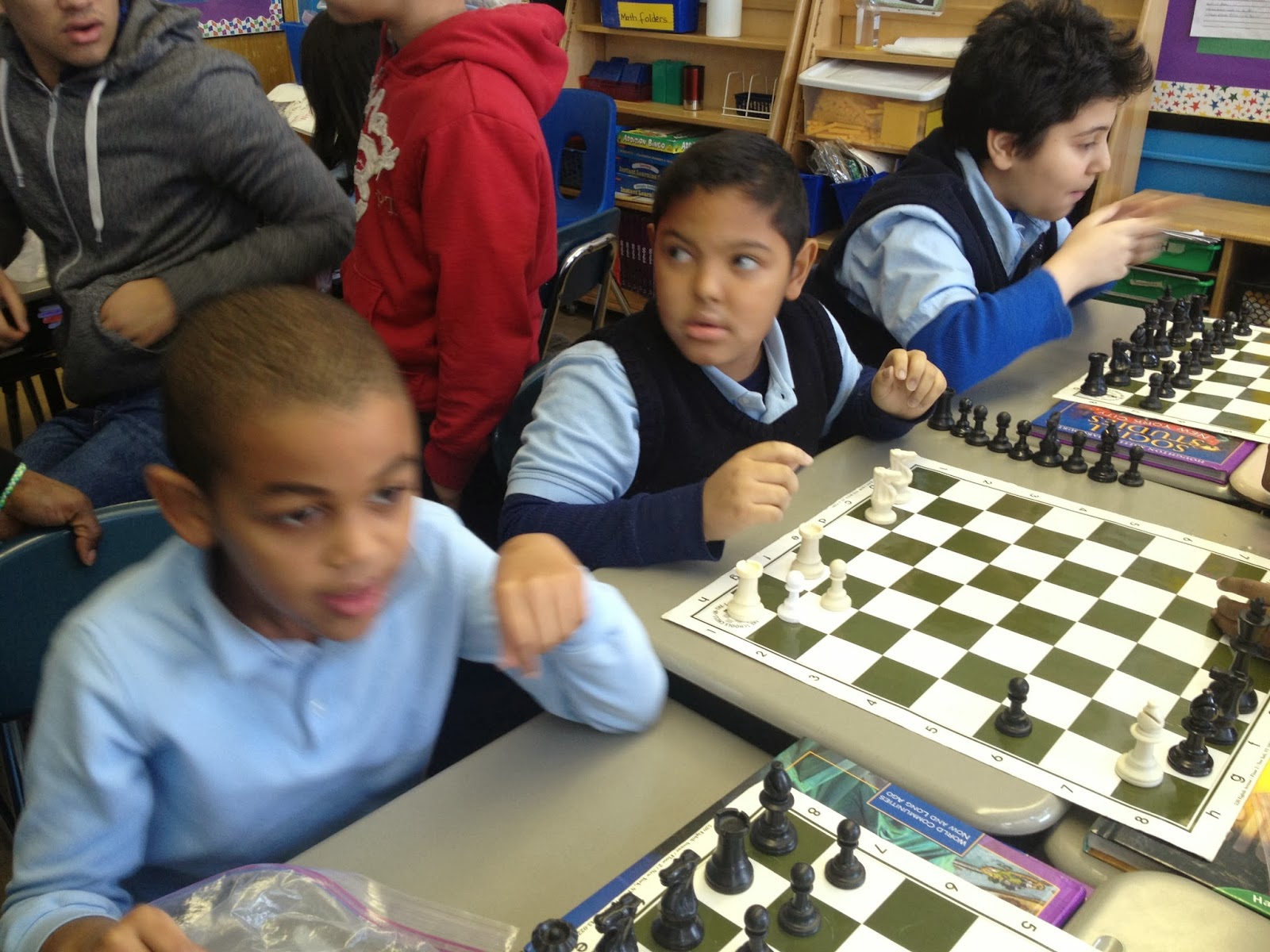
What a treat to watch Ms. Harris' 3rd and 4th graders enjoying playing chess with one another! They are smiling, having fun, learning the game well, and using critical thinking to plan their winning strategies!

BRAVO!